Resonance is the way your speech sounds as it goes through your mouth and nose. When you talk, sound is made in your voice box (larynx). The sound vibration moves through your mouth and nose to:
- become louder
- be shaped into sounds and words
How sound moves
When you talk, there is an ideal balance for sounds that are made through your nose and mouth:
- M, n, or “ing” are nasal sounds that move through your nose.
- Other consonants and vowels are non-nasal sounds that mostly move through your mouth.
The roof of your mouth (palate) is hard at the front and soft at the back. The soft palate is made up of a group of muscles at the back of your mouth that open and close to control the amount of air and sound that goes through your nose (nasal cavity) when you talk. Some people can see their soft palate if they stand in front of a mirror, open their mouth wide, and say “ah-ah-ah.” The dangly tissue that moves up and down is a part of the soft palate.
When the soft palate is open, sound goes through your nose. This is called nasal articulation.
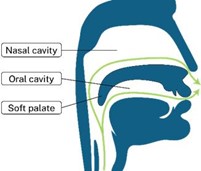
Image credits: Alberta Health Services
When the soft palate is closed, sound goes out your mouth (oral cavity). This is called oral articulation.
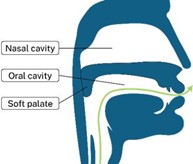
Image credits: Alberta Health Services
This means:
- The soft palate moves up and back to stop air from going through the nose when you say vowels and non-nasal consonants.
- The soft palate stays down to let air move up and through the nose when you say nasal consonants.
Hyponasal resonance
Hyponasal resonance means too little sound may come through your nose. This can happen when your nose is blocked, from a cold or allergies, enlarged adenoids, nasal polyps, or other structural blockages.
Hypernasal resonance
Hypernasal resonance means too much sound comes through your nose. This happens when your soft palate doesn’t stop air from going through your nose. Some people describe the sound as “talking through your nose.”
It can be caused when:
- The soft palate is too short or doesn’t close properly.
- Nerves or muscles of the soft palate are damaged.
- There are holes in any part of the soft or hard palate, such as if you have a cleft palate or following trauma or cancer.
Treatments for hypernasal resonance include:
- speech therapy to help improve how you make speech sounds and train your soft palate to close better
- a special speech device (prosthetic appliance) you wear in your mouth
- surgery to correct any issues with your palate
Where to get help
If you have concerns about your resonance, visit your healthcare provider.
Speech-language pathologists and audiologists can help with speech, language, and hearing concerns. Ask your healthcare provider or visit Adult Community Rehabilitation or Pediatric Rehabilitation to learn more.